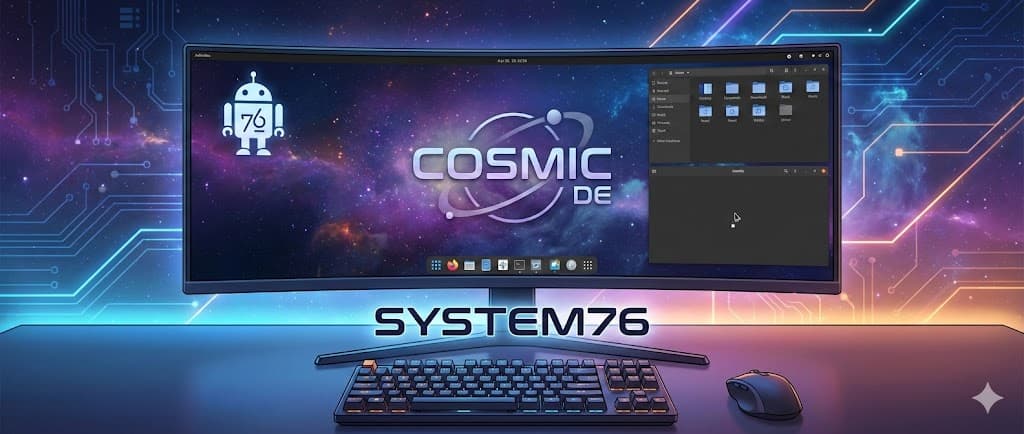
The Rust Experiment: System76's Cosmic
For years, the Linux desktop ecosystem has been defined by two gravitational poles: GNOME and KDE Plasma. While other environments exist, they generally function as satellites to these giants, relying on their toolkits (GTK and Qt).
System76, the Colorado-based hardware manufacturer, spent years curating a specific workflow on top of GNOME Shell via their Pop!_OS distribution. But eventually, they hit a hard ceiling. The limitations of retrofitting a tiling window manager onto a desktop built on single-threaded JavaScript (GJS) became untenable. Their solution was to burn the bridge and build a new one.
The Architecture: Why Rust Matters
To understand the hype and the skepticism, you have to look at the stack. Most Linux users are accustomed to the occasional stutter in GNOME when an extension hangs the main thread. This happens because GNOME Shell relies heavily on JavaScript for its UI logic, which is garbage-collected and single-threaded. COSMIC abandons this. It is built on Rust, utilizing a custom toolkit called libcosmic which sits on top of iced (a cross-platform GUI library). The implications for system resources are massive. By leveraging Rust’s memory safety guarantees without the overhead of a garbage collector, COSMIC achieves a level of concurrency that feels startlingly snappy.
When you look at the compositor cosmic-comp it is a Wayland-native display server. There is no X11 legacy code holding it back. It implements a rendering pipeline that feels distinct from Mutter (GNOME) or KWin (KDE). It is utilitarian and raw. The architectural thesis here is simple: stability through type safety, and speed through compilation.
The GUI and The "Tiling" Identity
Visually, COSMIC does not veer strictly away from the familiar "dock and panel" paradigm, but the behavior is where the philosophy shifts. It treats the window manager not as a passive container, but as an active organizational tool.
The Auto-tiling feature, originally a shell extension in previous versions of Pop!_OS, is now intrinsic to the compositor. The difference in responsiveness is palpable. In older versions, you might see a split-second ghosting effect as the shell calculated window geometry via JavaScript. In COSMIC, the window snaps into a tile instantly. A distinct feature catching users' eyes is the Stacking mechanism. It allows you to group windows into tabs within a single tiled frame, think of it like a web browser for your applications. This solves the "too many terminals" problem that plagues tiling window manager users.
However, the GUI is where the friction lies. Because libcosmic is new, it lacks the decades of polish found in Qt or GTK4. The theming engine is robust, allowing for individual corner rounding and transparency settings -- a level of granularity usually reserved for config-file editing in Arch Linux -- but it can feel stark.
Community Sentiment: The Polarity of Innovation
The reception has been a mixture of fervent optimism and pragmatic frustration. I’ve scoured the darker corners of Reddit, Phoronix forums, and X (formerly Twitter) to gauge the real user experience beyond the press releases.
The Praise:
- Performance is king. Users are consistently noting that "input lag is virtually non-existent." The overhead of the desktop is incredibly low compared to a fully loaded GNOME session.
- The "Goldilocks" Workflow. Many users feel System76 has found the middle ground between a Tiling Window Manager (like i3 or sway) and a full Desktop Environment. One user noted on a thread that "it lowers the barrier to entry for keyboard-driven workflows without forcing you to edit config files to change your volume."
- Customization. The modularity is a massive hit. You can strip the panels, move the dock, or rewrite the applets because the architecture is modular by design, distinct from the monolithic nature of GNOME.
The Criticism:
- "Alpha" vibes. Despite the LTS tag on the OS, the desktop environment still exhibits growing pains. Users have reported issues with drag-and-drop functionality in the file manager and varying degrees of support for system tray icons for non-native apps.
- The Fragmentation Argument. There is a vocal contingent of the Linux community that views COSMIC as unnecessary fragmentation. The argument is that System76 should have contributed upstream to GNOME or KDE rather than "reinventing the wheel."
- Theming inconsistencies. While GTK apps look okay in COSMIC, they don't look native. The visual disparity between a
libcosmicapp and a legacy GTK3 app is noticeable.
The Future: The "Epoch" Strategy
System76 is not treating this as a finished product, but rather a platform. Their CEO, Carl Richell, has been active on social platforms, outlining a vision that extends beyond just a desktop interface.
In interactions on X, the development team has hinted at the concept of COSMIC Sync (slated for future releases). The goal is ambitious a mechanism to sync your desktop settings, wallpaper, and panel configuration across devices securely. This would effectively decouple the user environment from the hardware, a feature that currently requires hacky scripts and Git repositories to manage.
Furthermore, the "COSMIC Epoch" roadmap suggests a move toward a release model that sits between fixed and rolling. By decoupling the desktop environment updates from the underlying Debian/Ubuntu base, they aim to ship features faster.
Verdict
COSMIC is a technical marvel because it proves that a hardware company can build a software platform that rivals giants like Red Hat (GNOME) and the KDE community. It is rough around the edges, like text rendering can be finicky and app support is growing slowly, but the foundation is pretty rock solid. It is the first mainstream desktop environment to take the "Rust safety" promise and apply it to the pixel pipeline. I am particulaly exited for the applets in Cosmic which allow you to add custom touches to the desktop experience.
For IT professionals and power users, it represents the first genuinely new idea in the Linux desktop space in a decade.
Good job System76!